Sharma Pankaj
Why 90% of Etsy Art Shops Fail (And How to Avoid It)
Struggling on Etsy? Learn why most art shops fail and how to avoid costly mistakes with proven strategies for sustainable growth.

A Strategic Guide for Artists, Digital Creators, and Print-on-Demand Sellers
Etsy has completely democratized the creative market, making it easier than ever to launch an online business. Today, finding a sustainable print on demand service for etsy or setting up a standalone digital storefront allows any creator to gain immediate access to millions of potential global buyers. Drawn by this massive audience, thousands of optimistic entrepreneurs open new storefronts daily, trying to build a business around etsy print on demand art prints or physical canvases. Yet, behind the headline-grabbing success stories lies a sobering statistical reality: roughly 90% of creative digital shops quietly close their doors within their first year. For those trying to scale, identifying the best printful alternative for etsy sellers or mastering basic e-commerce logistics can mean the difference between thriving and shutting down completely.
Why do so many talented creators hit a brick wall? The answer isn't a lack of artistic capability; it's a structural misunderstanding of platform data. Far too many beginners launch general print on demand posters etsy without realizing they are entering a highly competitive, algorithmic marketplace. To build a sustainable storefront, you must think like an e-commerce strategist rather than a passive hobbyist—which means discovering a reliable print on demand for etsy sellers workflow and actively sourcing a flexible print on demand alternative for etsy sellers if production bottlenecks occur. Success on this platform is rarely a stroke of luck; it is the direct byproduct of deliberate market research, strict data optimization, cohesive branding, and operational consistency. By analyzing the structural errors that doom the majority of creative shops, you can actively position your business within the profitable top 10%.
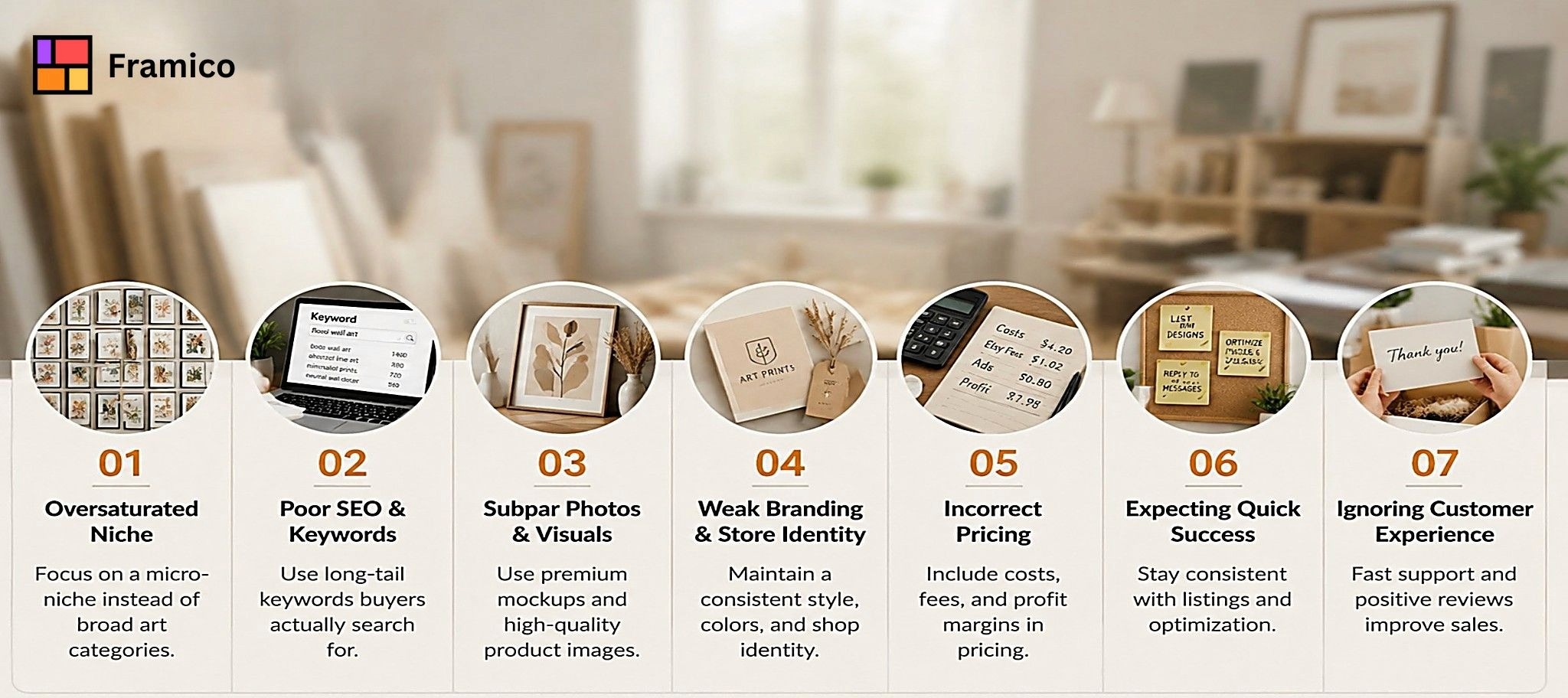
Mistake #1: Choosing an Oversaturated Niche
A major pitfall for incoming creators is launching a shop with incredibly broad, generic product offerings. Launching a catalog filled with basic "minimalist line art" or standard "boho floral prints" is a recipe for invisibility. When you design your inventory for everyone, you end up appealing to no one. Entering a crowded market without a hyper-specific aesthetic point of view makes it impossible to cut through the noise of millions of existing listings.
The top-performing 10% of sellers circumvent this trap by drilling down into hyper-focused micro-niches. Instead of offering general nature prints, they might specialize exclusively in "moody Pacific Northwest forest photography" or "gothic dark academia oil paintings."
Your primary job is to discover passionate subcultures, underserved hobbies, or specific interior design movements that are starving for high-quality visual content. Standing out through micro-specialization is your strongest defense against becoming a generic, ignored commodity.
Mistake #2: Flawed Etsy SEO and Suboptimal Keyword Mapping
The classic "build it and they will come" philosophy is the fastest path to zero sales. If your product titles rely entirely on simple, literal descriptions like "Pretty Blue Painting Canvas," your ideal customers will never find you. Etsy’s search algorithm operates as a matchmaker, heavily relying on Search Engine Optimization (SEO) to pair a buyer's specific search query with the most relevant products available.
Failing to execute disciplined keyword research means you are merely guessing what consumers want rather than acting on empirical market data. You must employ long-tail keywords that signal strong purchase intent.
Instead of tags like "art" or "poster," optimize your listings with multi-word phrases that reflect exactly how a human types into a search bar—such as "vintage mid-century modern kitchen art" or "retro surrealist space poster."
Mistake #3: Subpar Listing Photos and Amateur Visual Presentations
Within a physical gallery, a patron has the luxury of feeling the textured canvas paper, judging the print weight firsthand, and viewing the true, uncompressed depth of your color palette. In an online store, your primary listing photo has to do all of that heavy sensory lifting simultaneously. A massive percentage of shops collapse simply because their product photography looks poorly lit, amateurish, or artificially flat.
Relying strictly on the generic, default digital mockups supplied by your printing partner is an immediate red flag to buyers. If hundreds of competing stores use the exact same digital frame against the exact same stock living room wall, your shop's perceived authenticity vanishes. High-converting storefronts differentiate themselves by investing in premium, photorealistic lifestyle mockups, or by printing physical proof copies to shoot original, beautifully styled, and uniquely lit photography.
Pro Tip: Your artwork might be museum-quality, but if your listing image looks like it was snapped in a dark closet, its perceived market value plummets to zero. Online shoppers don't just buy your art; they buy the aspirational lifestyle your product photo promises.
Mistake #4: Weak Branding and Store Identity
A telltale sign of a failing Etsy shop is a disjointed, chaotic storefront. When a consumer clicks onto a shop page and sees pastel nursery prints sitting right next to neon cyberpunk street photography and holographic cartoon stickers, they instantly lose confidence. A fragmented shop layout signals to the buyer that the operation is amateurish, uncurated, and disorganized.
Developing a unified, recognizable brand identity is what transforms a casual, one-time browser into a dedicated collector. This means defining a disciplined color palette, establishing consistent typography, uploading a polished shop banner, and writing an authentic, engaging narrative in your "About Me" section. Your shop needs to feel less like a chaotic digital flea market stall and more like a carefully curated boutique gallery.
Mistake #5: Incorrect Pricing Strategy
Determining the monetary value of art is highly subjective, causing new sellers to frequently swing between two extreme pricing errors: underpricing their items out of imposter syndrome, or overpricing them before establishing the brand equity to justify it. Underpricing your work does more than just erode your profit margins; it inadvertently indicates to potential customers that the artwork is of inferior quality or lacks exclusivity.
To build a sustainable business, you must calculate a rigorous pricing formula that accounts for:
Raw production and material costs
Etsy's listing and transaction fees
Payment processing deductions
Marketing and advertising budgets
Your final retail price must respect your creative labor and cover all platform overhead while still leaving a healthy, scalable profit margin.
Mistake #6: Expecting Quick Success Without Consistency
The romanticized internet myth of e-commerce as effortless "passive income" has led countless creators astray. It’s common to see a new artist upload ten listings, wait two weeks, and abandon the storefront out of sheer frustration when a wave of automated sales fails to materialize. Etsy is fundamentally a long-term compound game that rewards persistent operational discipline.
The marketplace algorithm heavily favors active, dynamic storefronts that routinely introduce fresh inventory, renew older listings, and maintain consistent user engagement. It takes time for the platform's search engine to properly index your metadata and learn exactly which audiences respond best to your work. Treating your shop as a living, evolving business that demands weekly optimization is the ultimate differentiator between temporary hobbyists and career earners.
Mistake #7: Ignoring Customer Experience and Reviews
Etsy explicitly factors a shop’s customer service history directly into its organic search ranking system. Slow response times to customer inquiries, unaddressed shipping delays, and hostile dispute resolution will quickly trigger a drop in your search visibility. For a young shop, early negative feedback can be fatal, as a single one-star review can permanently destroy consumer confidence before the business ever gets off the ground.
On the flip side, obsessive customer service can act as an absolute growth catalyst. Answering buyer messages within a few hours, providing transparent tracking details, offering explicit digital download instructions, and adding personal touches to physical packaging creates an unforgettable consumer experience. Delighted buyers eagerly leave detailed five-star reviews, providing the essential social proof required to turn future browsers into high-ticket buyers.
Also Read: Canvas Print On Demand: The Ultimate Guide for 2026 by Framico
How Successful Etsy Art Shops Stand Out
The top tier of creative e-commerce entrepreneurs treat their artistic passion with corporate-level professionalism. They routinely execute competitor audits, track shifting seasonal search patterns using advanced analytics tools, and continuously optimize their older listings. If their current supply chain experiences bottlenecks, they don't panic; they quickly adapt to keep fulfillment seamless and guarantee rapid delivery times.
Crucially, top-tier shops do not rely exclusively on Etsy’s internal search ecosystem for their traffic. They build their own independent traffic pipelines by pulling back the curtain on their creative process across platforms like TikTok, Instagram, and Pinterest. By funnelling their own highly targeted audience directly to their listings, they construct a resilient, diversified business model that can easily withstand sudden marketplace algorithm updates.
Actionable Checklist for New Etsy Sellers
To ensure your creative shop launches on a rock-solid foundation, check off these five strategic essentials:
Validate Your Niche: Confirm that your artwork appeals directly to a passionate, identifiable subculture or specific design trend rather than a generalized category.
Maximize Your Metadata: Ensure all 13 tags per listing are completely filled with descriptive, multi-word, high-volume search phrases.
Audit Your Visuals: Replace sterile, low-res stock mockups with high-quality, aspirational lifestyle imagery that accurately showcases the scale of your prints.
Map Your Margins: Build an exact pricing spreadsheet that tracks every single platform fee, production cost, and ad dollar to ensure you remain profitable.
Systematize Customer Service: Draft clear, polite message templates for order confirmations, FAQs, and shipping delays to secure your Star Seller badge early.
Final Thoughts – Building a Sustainable Etsy Art Business
The intimidating 90% failure rate among creative Etsy storefronts shouldn't make you hesitate; it should give you immense confidence. Now that you understand the exact operational flaws that cause standard shops to fall apart, you possess the definitive strategic blueprint to build a highly resilient, highly profitable alternative.
Succeeding on Etsy doesn't mean you have to compromise your creative voice or commercialize your artistic soul it simply requires you to proudly step into your role as an active business owner. By marrying your unique creative talent with a disciplined, data-driven e-commerce strategy, you can transform your creative outlet into a thriving, scalable digital enterprise.visit Framico.
FAQ:
1. Why do most Etsy art shops fail within the first year?
Ans. Most Etsy art shops fail because they choose oversaturated niches, ignore SEO, use poor product images, and lack a clear branding strategy. Consistency and customer experience also play a major role in long-term success.
2. How can I make my Etsy art shop stand out from competitors?
Ans. You can stand out by focusing on a specific niche, creating unique artwork, using high-quality lifestyle mockups, building a strong brand identity, and optimizing listings with targeted keywords.
3. What is the importance of SEO for Etsy sellers?
Ans. Etsy SEO helps buyers discover your products through search. Using relevant long-tail keywords in titles, tags, and descriptions increases visibility and improves the chances of generating sales.
4. How should I price my Etsy art products?
Ans. Your pricing should include production costs, Etsy fees, payment processing charges, marketing expenses, and a healthy profit margin. Avoid underpricing, as it can reduce perceived value.
5. How important are customer reviews on Etsy?
Ans. Customer reviews are extremely important because Etsy considers customer service and reviews when ranking shops. Positive reviews build trust, improve visibility, and encourage more buyers to purchase.